

You are walking your dog through the neighborhood on a quiet evening. This is the same pup who has always been incredibly friendly, wagging his tail at everyone and greeting strangers with pure joy.
Out of nowhere, he lunges at a passing jogger with his teeth bared, growling in a deep, scary way you have never heard before. Your heart drops straight into your stomach. You look down and do not even recognize your own animal anymore, and you start spinning out, wondering if something is deeply wrong with his brain.
You worry he is dangerous, and a wave of guilt hits you because you feel like you have failed him completely.
But here is something most owners do not hear enough: your dog is not broken, and he is not a bad guy. He is just trying to talk to you. Aggression in dogs is almost never a random personality flaw or a sign of a malicious animal.
It is a desperate form of communication. Something is feeling totally wrong in his world, and your pup has simply run out of quieter ways to say so. Trying to understand what he is actually trying to tell you is the only real place to start.
Key Takeaways
- Your dog is not malfunctioning or trying to rule the house. He is using his body and teeth to tell you he feels unsafe.
- Sudden behavioral shifts are almost always tied to physical discomfort, so a trip to the vet is your top priority.
- Dogs rarely bite out of the blue, as they usually broadcast their discomfort early through subtle signs like lip licking.
- Tiny breeds often resort to snapping because the giant world around them feels incredibly threatening.
- A dog might inherit a high-strung personality, but great socialization and a predictable home life change everything.
- Getting a pro on your team early keeps everyone safe and takes the heavy guesswork off your shoulders.
Understanding Aggressive Behavior in Dogs
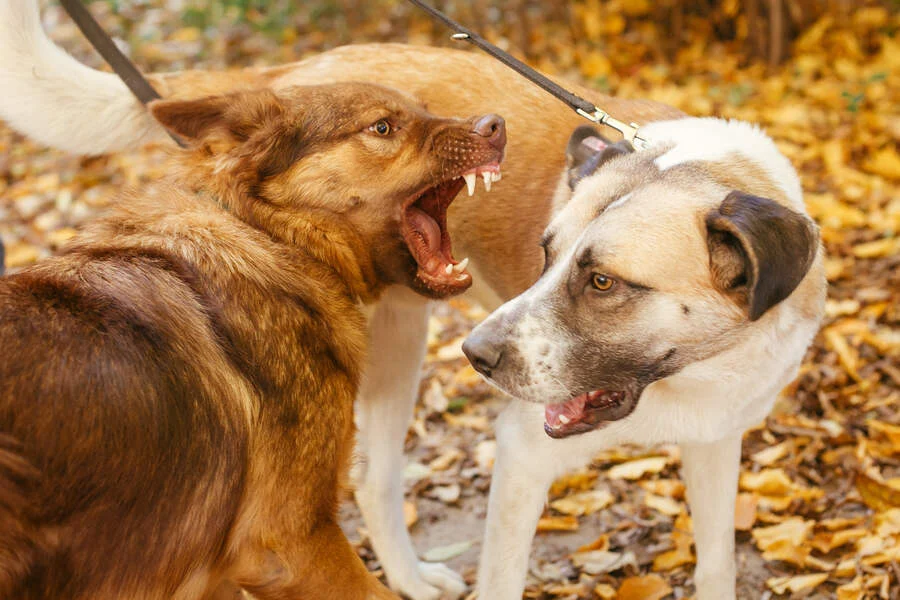
Aggressive behavior in dogs covers a massive, complicated spectrum. It can show up as a low, rumbling growl when a stranger steps too close to a food bowl, or it can look like a chaotic, lunging mess at another dog during a leash walk.
But if you look closely at every single point on that spectrum, you will see that the dog is just trying to communicate. Aggression is not random, and it is not proof that you are living with a broken animal. It is a loud, alarming signal that something in your dog’s life is totally out of alignment.
Dogs are naturally wired to show discomfort through a slow, graduated series of body signals. When people ignore, laugh off, or punish those quiet warnings, dogs learn that subtlety gets them nowhere, and so they escalate to get their point across.
What looks like sudden aggression is almost always the final chapter of a long story that started weeks ago with quiet, anxious messages that went completely unread.
Core drivers of aggression
- Medical factors: Chronic pain, wonky hormone levels, and hidden neurological conditions can lower how much stress a dog can handle before exploding.
- Behavioral factors: Deep-seated fear, terrible early socialization, and generalized anxiety completely warp how a dog views his surroundings.
- Environmental factors: Tough handling styles, letting bad habits repeat, and confusing household rules determine if a dog’s vulnerabilities get better or multiply.
Figuring out what is actually driving the behavior always has to happen before you try to fix it. Jumping straight into heavy training techniques without knowing the root cause is a waste of time, and it can actually make the behavior significantly worse.
And let’s be honest, a dog who is growling because his hips hurt needs a compassionate veterinarian, not a behavioral correction.
Types of Aggression in Dogs
Not all aggression looks the same, and different reactions mean completely different things. Pinpointing the exact flavor of aggression you are looking at is the essential first step toward helping your pet feel safe again.
- Fear aggression: This is the most common form by far, and it happens when a dog senses a threat and feels like he has zero escape routes. The dog is not attacking because he wants to be a bully; he is attacking because he feels cornered and desperate. A fear-aggressive dog usually tries to back away first, then freezes stiff, and finally snaps when people keep pushing past his boundaries.
- Resource guarding: This pops up when a dog feels like his favorite possessions are about to be stolen. It could be his kibble, a favorite squeaky toy, a comfy spot on the couch, or even a specific human in the house. This is a deeply instinctual survival behavior, and the dog is not being spiteful or greedy. Pushing past a dog’s warning growl over a bone just teaches him that growling is useless, so he will skip straight to a bite next time.
- Territorial aggression: This develops when dogs feel like their home base is being invaded by outsiders. It usually targets unfamiliar delivery workers or neighborhood animals, and it tends to peak intensely between one and three years of age. A dog barking wildly at the backyard fence is just doing what his DNA tells him to do when his bubble feels threatened.
- Redirected aggression: This happens when a dog gets highly frustrated by a trigger he cannot physically reach, like a stray cat outside the window, so he turns around and vents that chaotic energy on whoever is standing closest to him.
- Pain-induced aggression: This is a direct, protective reflex to physical discomfort when someone accidentally touches or moves a hurting joint.
- Inter-dog aggression: This behavior is directed specifically toward other dogs and is usually rooted in natural competition, fear, or a total lack of early social skills around his own species.
Each type carries its own message. Learning to read which type is present, and why, is the foundation of any meaningful behavior change. For a deeper look at how these categories are addressed through structured training, tackling dog aggression with training covers the full range of types and the approaches that work for each.
Sudden Aggression Triggers
Why is my dog suddenly aggressive? When a dog changes his whole personality overnight after years of being perfectly sweet, you need to book a veterinary exam immediately. Sudden behavioral shifts are the clearest indicator that a medical issue is brewing beneath the surface.
| Potential Cause | What is Happening | How it Manifests |
| Hidden Pain | Arthritis, bad teeth, or ear infections hurt constantly. | Snapping when you try to touch or move them. |
| Sensory Loss | Vision or hearing fades due to age or disease. | Getting startled easily and reacting defensively. |
| Missed Signals | Humans missed early signs like lip licking or freezing. | The dog escalates to biting to finally get a reaction. |
Big environmental changes can also push a dog right past his ability to cope, and things like bringing home a new baby, moving to a new house, loud neighborhood construction, or a sudden shift in your work schedule can stress a dog out completely.
Simple boredom plays a massive role too, because dogs left alone for long hours without any mental stimulation develop reactive tendencies just to release their pent-up, crazy energy.
Even reproductive status changes things, since intact males will fight intensely over a female in heat, and new mother dogs can display fierce protective aggression that completely shocks their owners.
In every single one of these scenarios, the dog is communicating a specific stressor rather than just malfunctioning like a broken machine.
Aggression in Puppies
Puppies nip, wrestle, and make plenty of noise, and that is a normal part of growing up. But there is a massive difference between rowdy puppy play and genuine aggression in youngsters.
Learning to tell them apart early can change the entire trajectory of your dog’s adult life. Normal play involves a lot of fun back-and-forth interaction with frequent natural pauses, and the puppies release their grip quickly after grabbing each other. Their noises are high-pitched and silly, and their bodies look loose, goofy, and bouncy.
Early aggression looks completely different, as the intensity is entirely one-sided and the puppy grabs hold of skin or clothes without wanting to let go. You will hear deep, tense growls that sound way too serious for a baby, and the puppy’s body will go totally rigid while he stares hard at his target. He might even curl his lip back and deliver intentional, painful bites.
The socialization window between three and 14 weeks of age is the most critical period of a dog’s whole life. Puppies who get safely exposed to a wide variety of people, animals, and strange noises during this time are significantly less likely to develop fear-based behaviors later on.
Puppy aggression can also be triggered by pure exhaustion or overstimulation, but you should never just dismiss it as a phase he will grow out of. Aggressive patterns established in puppyhood become incredibly tough to untangle once the dog reaches social maturity around two or three years old.
How to distinguish normal puppy play from early signs of aggression
| Normal Puppy Play | Early Signs of Aggression |
| Back-and-forth interaction with pauses | No back-and-forth; one-sided intensity |
| Releases quickly after grabbing | Grabs and holds without releasing |
| Playful, high-pitched vocalizations | Deep growls that sound distinctly tense |
| Loose, bouncy body posture | Body rigidity and hard staring |
| Exploratory nipping | Intentional bites with a curled lip |
Aggression in Small Dogs
Small dogs bite, too, and they actually do it far more often than many people realize or want to admit. Research into breed behavior shows that aggression in small dogs occurs at higher rates than in large breeds, and Chihuahuas and Dachshunds are frequently identified as some of the most reactive pups around.
This happens largely because of fear-driven defensiveness. Smaller dogs tend to be more anxious overall, and when you only weigh 10 pounds in a world full of giants, defensive aggression feels like a completely rational survival strategy to keep from getting stepped on.
Our own habits as owners also create these bad patterns. Because a Chihuahua’s bite causes very little damage compared to a German Shepherd’s bite, people often let bad behaviors slide. Owners allow play biting, fail to enforce basic boundaries, and pick the dog up to carry him away from trouble rather than teaching him how to cope.
The little dog learns that acting like a monster works like magic to make scary things disappear, and the behavior becomes deeply ingrained. Small dogs deserve the exact same consistent training, socialization, and clear boundaries as any giant breed.
Summary: Why do small dogs display more aggressive behavior?
- Fear-driven defensiveness: Smaller dogs tend to be more fearful overall, and when you’re ten pounds in a world full of much larger creatures, defensive aggression can feel like a rational survival strategy.
- Owner-created patterns: Because a Chihuahua’s bite causes less damage than a German Shepherd’s, owners often let behaviors slide that they would never tolerate in a larger dog: allowing play biting, not enforcing boundaries, carrying the dog away from situations rather than teaching it to cope. The dog learns that aggression works. It gets picked up, the threat disappears, and the behavior is reinforced.
- Small dog syndrome: This pattern isn’t a character flaw in the dog. It’s a communication problem created by an environment that never gave the dog the structure it needed. Toy breed aggression is rarely about size. It’s about expectations. Small dogs deserve the same consistent training, socialization, and behavioral guidance as any other breed.
Senior Dog Behavioral Changes
When an old dog gets grumpy after years of being gentle and predictable, it is almost always a cry for help because something physical has gone wrong. Senior dog aggression is rarely about a sour temperament, and it is almost always about discomfort, confusion, or losing their senses.
Severe arthritis and dental disease cause chronic soreness that a dog cannot tell you about, so he uses his teeth to say “please don’t touch that” when you reach for him. Cognitive dysfunction syndrome, which is essentially dog dementia, is another massive factor to consider.
Dogs experiencing this decline get confused, disoriented, and easily startled, which leads to sudden reactive outbursts out of nowhere. If your older dog is acting out, get them to a vet quickly, because managing their pain can completely bring back your sweet old pup.
Gender Differences in Aggression
Are male dogs truly more aggressive than female dogs? The short answer is that it is complicated. Male dogs, especially unneutered ones, show higher rates of inter-dog aggression and resource competition.
Testosterone does not magically create aggression from nothing, but it definitely lowers the threshold at which a dog responds to annoying triggers, making his reactions faster and much more intense.
Neutering can help reduce these hormonally driven behaviors, but it is not a magic eraser and requires real training to back it up. Interestingly, some research shows that dogs neutered between seven and 12 months old can actually show an increase in aggression toward strangers, proving that hormones are not a simple on-and-off switch.
Female dogs are not perfect angels either. Unspayed females experience intense hormonal fluctuations during their heat cycles, and maternal aggression in a nursing mother can be incredibly sudden and fierce.
Ultimately, early socialization and a stable home environment matter way more than the sex of the dog when it comes to predicting behavioral problems.
Do male dogs display more aggressive behavior than females?
| Factor | Male Dogs | Female Dogs |
| Hormonal influence | Testosterone lowers threshold for reactive responses; intact males overrepresented in bite statistics | Heat cycles cause hormonal fluctuations that can affect behavior |
| Common aggression types | Higher rates of inter-dog aggression and competition-based aggression | Maternal aggression in pregnant or nursing females can be intense and sudden |
| Effect of spay/neuter | Neutering can reduce hormonally driven behaviors; some research notes increased stranger aggression in dogs neutered at 7–12 months | Spaying reduces heat-cycle-related behavioral fluctuations |
| Overall determining factor | Sex and reproductive status are contributing factors, not determining ones | Socialization and environment outweigh sex in predicting aggression |
Recognizing Early Warning Signs
Dogs almost always give plenty of warnings before they actually bite, but the problem is that most humans have no clue what to look for. Even worse, some dogs have been scolded or punished for growling so many times that they learn to skip the warning entirely and go straight for the bite to protect themselves.
The escalation ladder
- Early stress signs: Yawning when he isn’t tired, licking his lips, turning his head away, freezing perfectly still, or eating super fast.
- Visible warning signs: Stiff body posture, ears pinned tightly back, a high stiffly wagging tail, or a low, serious bark.
- Active escalation: Distinct growling, baring teeth, snarling, snapping the air, or delivering a firm nose punch to tell you to back off.
- The actual bite: The absolute last resort when the dog feels he has no other choice to make the terrifying stress stop.
Recognizing these signs of aggression early, and responding by removing the stressor rather than escalating the confrontation, is the single most effective way to prevent bites. It also builds trust: a dog whose early warnings are respected learns that it doesn’t need to escalate. For owners navigating these patterns, exploring expert solutions for dog behavior problems can provide structured guidance on reading and responding to these signals effectively.
Nighttime Aggression Patterns
Some dogs display aggression specifically after dark, and this frustrating behavior usually boils down to a few environmental and physical factors:
- Failing eyesight: Low light makes it incredibly hard for dogs with deteriorating eyes to recognize who is walking toward them, so they startle easily.
- Stiff, achy joints: Joint pain from arthritis gets much stiffer and more painful after a dog has been lying still on the rug all evening.
- Spooky sounds: Wild animals, neighbors, and passing cars sound much louder in the quiet dark, which spikes a dog’s territorial instincts.
Genetics Versus Environment
Genetics certainly matter, but they are absolutely not a life sentence. Some breeds do carry higher predispositions toward certain types of reactivity, and research often points to German Shepherds and Bull Terriers as breeds with elevated risks.
But a genetic predisposition is not a guaranteed outcome. A dog with reactive genetics who is well-socialized, raised with clear structure, and given great outlets for his energy will turn out wonderfully.
Meanwhile, a dog with perfect genetics who is isolated, neglected, and punished will likely become highly aggressive. Environment almost always wins the battle. Early socialization is your absolute best tool to teach a puppy how to navigate the world safely without relying on his teeth.
How genetics and environment interact to influence dog aggression
| Factor | Increases Aggression Risk | Reduces Aggression Risk |
| Genetics | Breed predispositions toward specific aggression types; purebred overrepresentation in dominance-related cases | Mixed-breed dogs show lower rates of dominance-related aggression in some studies |
| Early socialization | Isolation or very limited social contact in the first 3–14 weeks | Consistent exposure to varied people, animals, sounds, and environments |
| Training approach | Punishment as the primary training tool; inadvertent reinforcement of aggression | Structured environment with appropriate outlets for energy and instincts |
| Living conditions | Isolation and under-stimulation | Enriched environment with mental and physical engagement |
Early socialization is the single most powerful environmental tool available. Dogs raised with consistent exposure to varied people, animals, sounds, and environments develop the social fluency to navigate the world without defaulting to aggression.
Dogs raised in isolation, or in households where aggression was inadvertently rewarded or where punishment was the primary training tool, learn that the world is unpredictable and threatening. They communicate that belief through their behavior.
The good news is that environment is something owners can change. Obedience training programs that incorporate behavior modification are specifically designed to reshape the environmental patterns that contribute to reactive and aggressive behavior.
When to Seek Professional Help
If your dog has growled, snapped, or bitten anyone, professional treatment is not a dramatic, embarrassing last resort. It is simply the most responsible next step you can take for your family.
Trying to fix severe aggression on your own using internet tips can backfire terribly, as you might accidentally suppress their warning signals without fixing the root anxiety, creating an incredibly dangerous situation.
- Visit your vet first: Rule out all painful physical conditions, thyroid issues, or brain changes before doing anything else.
- Find a certified expert: Look for a certified professional dog trainer or a veterinary behaviorist who understands complex reactivity.
At The Dog Wizard, rehabilitating aggressive dogs is a core specialty we take to heart. With over two decades of hands-on experience and more than 100 locations, our trainers work with all breeds and sizes through structured Board & Train and Day Training programs.
We never want to just shut a dog up or suppress his voice. We want to deeply understand what he is trying to say and give him the tools to express himself safely.
Aggression always has an underlying cause, and those causes always have solutions. Your dog is not giving up on you, so hang in there and do not give up on him.
Frequently Asked Questions
Can a dog completely recover from aggression?
Yes, plenty of dogs overcome aggressive tendencies with the right combination of medical care, behavioral modification, and consistent management. While you may always need to manage certain triggers to keep them safe, dogs can learn to feel secure enough that they no longer feel the need to react aggressively.
Should I punish my dog for growling at me?
No, you should never punish a dog for growling. Growling is his way of saying “I am uncomfortable,” and if you punish it, you will successfully train your dog to stop warning you. However, you will not fix the underlying fear, meaning the dog may eventually bite out of nowhere without any warning at all.
Why does my dog act aggressive only when he is on a leash?
This is a super common issue called leash reactivity. The leash prevents your dog from using his natural choice to move away from things that scare him, leaving him feeling completely trapped. Because he cannot run away, he resorts to a dramatic defensive display by barking and lunging to scare the threat away first.