

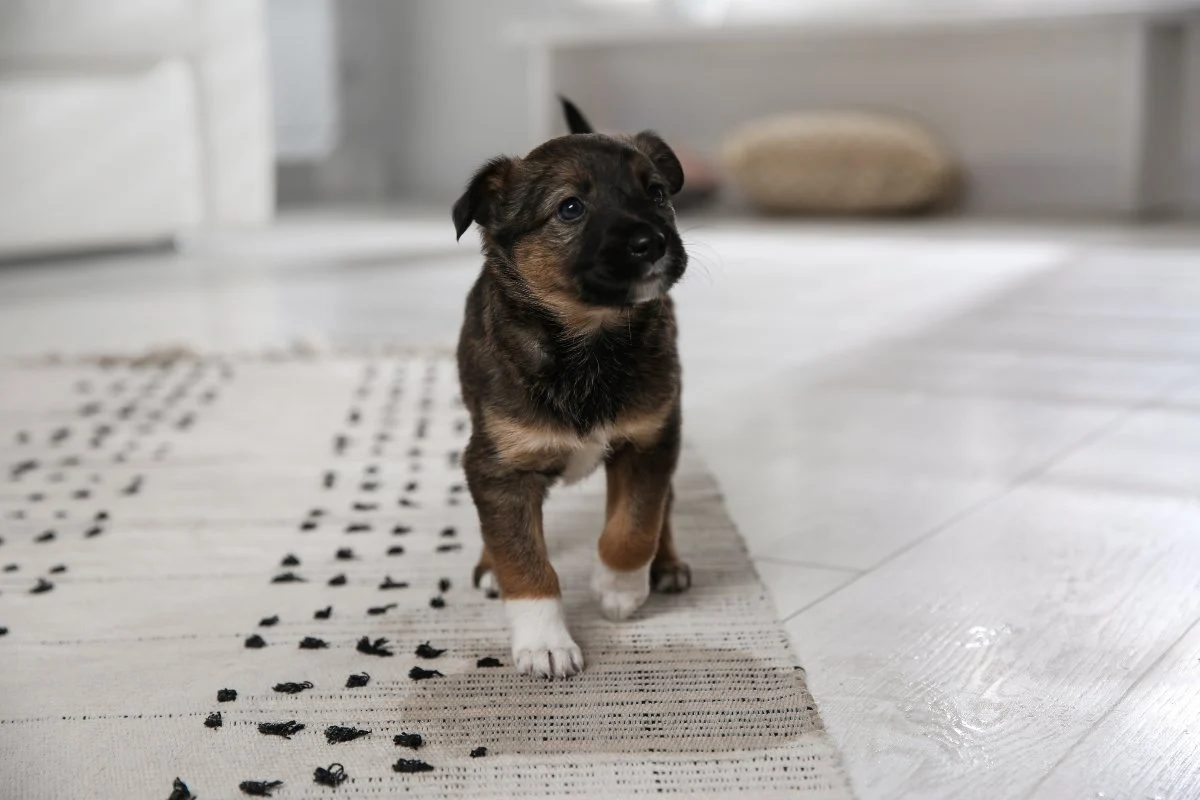
You wake up, shuffle into the kitchen, and there it is: a puddle on the floor and a puppy looking up at you with those big, innocent eyes. Sound familiar? If you’re in the thick of potty training right now, we want you to know something important: this isn’t misbehavior.
Your puppy isn’t being defiant or difficult. They’re simply going through a developmental stage, much like a toddler learning where the bathroom is. And just like with toddlers, the path forward is built on routine, patience, and encouragement and not frustration or punishment.
At The Dog Wizard, our certified trainers have helped thousands of families navigate this exact journey across more than 100 locations nationwide. We’ve seen it all, and we know that potty training succeeds when owners understand the “why” behind the process.
In this guide, we’ll walk you through everything: from your puppy’s biology to step-by-step outdoor training, handling accidents gracefully, and knowing when to ask for help. Let’s get started.
For more in-depth support, explore our expert puppy training programs.
QUICK ANSWER: Potty training works best when you:
- Start the day your puppy comes home
- Follow the one-hour-per-month bladder rule
- Take them out at predictable trigger times (after sleep, meals, play, before/after crating, last thing at night)
- Reward within 2–3 seconds of finishing outside
- Supervise closely or use a right-sized crate
- Clean accidents with enzymatic cleaner
Most puppies become reliably house-trained in 4–6 months. Full consistency can take up to a year, especially for small breeds.
Before You Start: What Potty Training Actually Requires
Your puppy isn’t being stubborn. Their bladder is just tiny.
Before you can train your puppy effectively, it helps to understand what’s actually happening inside that tiny body. Puppies are not small adult dogs. Their nervous systems, bladder muscles, and cognitive abilities are still very much under construction.
This is genuinely good news, because it means accidents aren’t a sign of stubbornness. They’re simply a sign of biology.
Rule of thumb: a puppy can hold their bladder for roughly one hour per month of age. So a two-month-old puppy can hold it for two hours, a three-month-old for three hours, and so on. Their developing nervous system means they often don’t feel the urge to go until it’s already urgent as there’s very little warning time built in at this stage.
Breed size also plays a meaningful role in your training timeline. Smaller breeds have smaller bladders, so they need to be taken out more than larger dogs and can take longer to potty train.
A Chihuahua puppy will need more bathroom breaks than a Labrador puppy of the same age, and that’s completely normal. Adjusting your expectations based on your puppy’s size will save you a lot of unnecessary frustration.
It’s also worth understanding the difference between submissive urination and a lack of training. Some puppies urinate when they’re excited or feel intimidated. This is an involuntary response, not a housetraining failure.
Punishing this behavior makes it worse. Recognizing which type of accident you’re dealing with helps you respond in the right way.
For a broader perspective on all aspects of raising a puppy, including training, potty, and socialization help, consider our comprehensive guide.
Development facts to remember
- Bladder capacity by age: A puppy can hold their bladder for roughly one hour per month of age.
- Developing nervous system: Puppies often don’t feel the urge until it’s urgent, leaving little warning time.
- Breed size: Smaller breeds have smaller bladders and may take longer to housetrain.
- Submissive vs. training: Excitement or intimidated urination is involuntary and not a housetraining failure.
The best age to start potty training
The short answer? Start the day your puppy comes home. The ideal time to start house-training puppies is as soon as you bring them home, which for most people is between 8 to 12 weeks. The earlier you establish a routine, the faster your puppy will learn what’s expected of them.
That said, puppies younger than 8 weeks genuinely lack the physical control needed to hold their bladder at all. If you’re bringing home a puppy at 8 weeks, which is the typical minimum age, understand that you’re starting at the very beginning of their ability to learn this skill.
They’ll need very frequent trips outside, and accidents will be plentiful. This is not a reflection of your training. It’s simply where they are developmentally.
By 12 to 16 weeks, most puppies begin to develop better awareness of their bodily functions and can start making the connection between going outside and receiving rewards. This is often when training really starts to click.
Some breeders begin introducing puppies to designated elimination areas before they go to their new homes, which can give you a small head start but you shouldn’t count on it. Be prepared to begin from scratch.
The most important thing to remember in these early weeks is that your puppy’s progress will be uneven. Some days will feel like breakthroughs while others will feel like you’re back at square one.
That’s completely normal, and it doesn’t mean you’re doing anything wrong. Consistency and patience are your most powerful tools right now.
Readiness by age
- 8 weeks: Very frequent breaks; minimal bladder control; accidents are expected.
- 12–16 weeks: Awareness improves; the outside–reward connection starts to click.
- Uneven progress: Breakthrough days and setback days are both normal; consistency wins.
The three pillars of successful house training
Mastering house training doesn’t require a magic wand. It requires a reliable framework built on the three pillars of Routine, Supervision, and Reward.
By establishing a consistent schedule, you teach your puppy when to go. By maintaining close supervision, you prevent accidents before they happen. And by offering immediate rewards, you reinforce that “doing their business” outside is the best decision they’ve ever made.
You’ll notice that punishment is absent from this list. Scolding or “rubbing their nose in it” only teaches a puppy to fear you or hide their accidents in the house. It never teaches them where the right spot actually is. Effective training is about building communication and trust, not anxiety.
The Puppy Potty Training Schedule That Works
If there’s one thing our trainers at The Dog Wizard emphasize above all else, it’s this: consistency is more powerful than any trick or technique.
Your puppy can’t tell time, but they can absolutely learn to predict what comes next. A predictable schedule means fewer accidents, faster learning, and a calmer puppy who knows what to expect from their day.
When to take your puppy outside
Certain moments in your puppy’s day are almost guaranteed to trigger the need to go. Make these non-negotiable parts of your routine:
- First thing every morning: their bladder has been holding all night and needs to empty immediately
- Within 15 minutes of every meal: eating stimulates the digestive system reliably
- After every nap, no matter how short: even a 20-minute snooze can prompt the need to go
- After every play session or excitement spike: physical activity and arousal increase urgency
- Before being left alone or put in the crate: always give them the opportunity to empty first
- Last thing every night: a final trip before bed reduces overnight accidents
- Every 30 to 60 minutes during active waking hours for puppies under 12 weeks
Age-by-age bladder control guide
| Age | Maximum hold time | Approximate trips outside per day |
|---|---|---|
| 8 weeks | ~1 hour | 10–12+ |
| 10 weeks | ~1.5 hours | 8–10 |
| 12 weeks | ~2 hours | 8 |
| 4 months | ~3 hours | 6–8 |
| 6 months | ~4–5 hours | 4–6 |
For training milestones beyond potty training, see our complete puppy training schedule by age from 8 weeks to 18 months.
Keep in mind that small breeds need more frequent trips at every stage, and individual variation is completely normal. These numbers are guidelines, not guarantees.
Sample daily schedule for a 10-week-old puppy
Here’s what a realistic day might look like for a working owner with a 10-week-old puppy:
- Out immediately upon waking around 6:30 a.m.
- Then breakfast followed by another trip outside by 7:00 a.m.
- A midmorning trip around 8:30 a.m., then again at 10:00 a.m.
- Lunch around noon with an immediate post-meal trip, followed by breaks at 1:30 p.m. and 3:00 p.m.
- An afternoon play session followed by an outdoor trip around 4:30 p.m., dinner at 5:30 p.m. with a post-meal trip, then breaks at 7:00 p.m. and 8:30 p.m.
- A final trip right before bed at 10:00 p.m., and potentially one overnight trip around 2:00 a.m.
Yes, it’s intensive but it gets much easier quickly, and the investment now pays off in weeks, not months.
How to Potty Train a Puppy: Step by Step
You’ve got your schedule and your patience. Now let’s talk about exactly what to do during each potty break to make it as effective as possible.
Step 1: Pick one dedicated potty spot
Always take your puppy to the same outdoor location. The scent of previous eliminations acts as a powerful cue, prompting them to go again in the same spot. Keep them on a leash outside while training, even in a fenced yard, so you can see what’s happening and react immediately.
Step 2: Add a verbal cue every single time
Choose a phrase like “go potty”, “do your business”, or “hurry up” and use it consistently every time, right as your puppy begins to eliminate. Within a few weeks, this cue will start to trigger the behavior on command. This becomes incredibly useful during travel, vet visits, or any time you need your dog to go on a schedule rather than their own timeline.
Step 3: Reward the moment they finish
This is the most critical step, and the timing matters enormously. Reinforce outdoor success within 3 seconds of the behavior for your puppy to make the connection. That means you reward outside, immediately after they finish and not after you walk back inside, not after you take off your shoes. Outside. Immediately. Use high-value treats for this stage, not regular kibble. This is a big deal, and the reward should reflect that.
Step 4: Give freedom time after success
Don’t march your puppy straight back inside the moment they finish. If going outside always ends the fun, your puppy may start to delay eliminating to prolong outdoor time or worse, they’ll learn that pottying ends the good stuff. Give them 5 to 10 minutes of outdoor play or supervised indoor time as a secondary reward. Pottying should predict good things, not the end of them.
Step 5: Manage the environment between trips
Between scheduled outdoor breaks, your puppy needs either direct supervision or confinement. There is no middle ground during active training. The tether method, which is keeping your puppy on a leash attached to you while you move around the house, is one of the most effective supervision tools available. It keeps them close enough that you’ll notice any pre-potty signals immediately. When you can’t supervise directly, the crate or a puppy-proofed exercise pen keeps them safe and prevents unsupervised accidents from becoming habits.
Myth busting: You may have seen claims about training a puppy in 3 or 5 days. We understand the appeal, but we’d be doing you a disservice if we didn’t tell you the truth: shortcuts in potty training almost always backfire. They create inconsistent habits and frustrated owners. The step-by-step approach above, applied consistently over weeks and months, is what actually works.
When Your Puppy Has an Accident (And They Will) Here’s What to Do
Here’s something we tell every family we work with: accidents are owner mistakes, not puppy mistakes. That’s not meant to make you feel bad. It’s meant to shift your perspective in a way that actually helps.
When an accident happens, it means something in the management system broke down: a scheduled trip was missed, supervision lapsed, or the puppy was given more freedom than they were ready for. Understanding this makes it much easier to respond calmly and constructively.
If you catch them in the act
If you catch your puppy in the act, stay calm. A gentle “ah-ah!” or a soft hand clap is enough to interrupt the behavior without frightening them. Immediately guide them to their outdoor potty spot. If they finish outside, reward them enthusiastically as they did the right thing in the end, and that deserves celebration. No drama, no anger. The goal is redirection, not correction.
If you find it after the fact
If you find an accident after the fact, here’s the most important thing: do not punish your puppy. If you discipline your puppy for housebreaking mistakes, it can backfire. Your puppy doesn’t understand that you don’t want them to go there. They think you don’t want them to go at all. That can result in your puppy sneaking off to hide it, and may cause them to be reluctant to go outside in front of you.
How to clean up properly
When you find an accident, simply clean it up without fanfare and reflect on what led to it. Use enzymatic cleaner and not regular household cleaner to eliminate the odor completely. Dogs’ noses are incredibly sensitive and they can detect leftover molecules, which might prompt them to revisit the same spot.
Why your puppy keeps having accidents in the same spot
Enzymatic cleaners thoroughly break down these molecules, eliminating the scent entirely. For carpets, use more product than you think you need. Residual scent is the number one reason puppies return to the same spot repeatedly. Once the scent is gone, the behavioral pull to that location disappears with it.
Cleanup essentials
- Interrupt calmly: Use a gentle sound, guide outside, and reward if they finish there.
- No punishment: It creates fear and sneaky elimination without teaching the right behavior.
- Enzymatic cleaning: Saturate the area to eliminate residual odor molecules.
- Review management: Missed trips, lapses in supervision, or too much freedom are common causes.
Why Punishment Doesn’t Work for Potty Training (And What to Do Instead)
At The Dog Wizard, we believe that true mastery over any behavior comes from clarity, not fear. While old-school methods might suggest “showing them who’s boss,” science and experience tell a different story.
Punishment doesn’t actually teach your puppy where to go. It simply teaches them that you are unpredictable. To earn your puppy’s trust and see real results, you have to swap the rolled-up newspaper for a better strategy.
Your puppy isn’t “being defiant”, they’re just learning
It is a common misconception that a puppy who has an accident on the rug is “getting back at you” or being stubborn. In reality, your puppy has no innate concept of “the rules” or the value of your hardwood floors.
Potty accidents are developmental, not behavioral. Punishing a young puppy for an accident is equivalent to punishing a human baby for crying or needing a diaper change. It communicates nothing useful because the puppy lacks the physical control and cognitive understanding to do otherwise.
They aren’t trying to break your rules. They simply haven’t learned them yet.
What happens to puppies who are punished for accidents
When a puppy is scolded or intimidated for an accident, they don’t associate the punishment with the location of the mess. They associate it with the presence of the owner.
This leads to a common, frustrating cycle: the puppy becomes afraid to eliminate in front of you. Instead of learning to go outside, they learn to sneak off and go behind the couch or in an empty guest room where they feel safe from your reaction.
Research in canine behavior consistently shows that aversive training methods increase cortisol levels and anxiety, leading to slower overall progress and, most importantly, damaging the human-dog bond during a critical developmental window.
The reward-based alternative that works faster
The secret to fast, reliable house training is making the right choice the most rewarding choice. Positive reinforcement creates a puppy who actively wants to go outside because they know “great things happen there.”
When you catch that moment of success outdoors and follow it with high-value praise or a treat, the behavior becomes self-reinforcing. By focusing on rewards, you aren’t just potty training. You are laying a foundation of confidence and clear communication that will make every future training challenge, from leash walking to “stay”, significantly easier to conquer.
Potty Training Challenges and How to Solve Them
Even with a solid plan, the road to a fully house-trained dog often has a few bumps. The key is to view these challenges as puzzles to solve rather than signs of failure. Here is how to navigate the most common hurdles owners face.
“My puppy goes outside then has an accident right when we come back in”
It is incredibly common for a puppy to sniff around outside, do a “quick” potty, and then finish the job on your rug five minutes later. Usually, this happens because they didn’t fully empty their bladder or bowels as puppies are easily distracted.
To fix this, stay outside longer, even if they’ve already gone once. Spend up to 10 or 15 minutes outdoors and keep them moving. Walking around helps stimulate the gut and ensures they are actually “done” before they head back inside. Patience beats frustration every single time.
Potty training a puppy when you work full-time
Life doesn’t stop just because you have a new puppy, but a young dog physically cannot hold it for eight hours. You’ll need a realistic mid-day plan, such as hiring a dog walker, asking a neighbor for a break, or using a pet sitter.
If you can’t get someone there, a puppy-proofed confinement area with a pee pad as a backup is a practical, if not ideal, solution. For those with demanding schedules who want a head start, a professional board-and-train can be a game-changer, providing intensive, consistent structure during those early weeks.
Small breed puppies take longer: here’s why
If you have a Yorkie or a Chihuahua, you might feel like you’re behind the curve. It isn’t a character flaw or a lack of intelligence. It’s simple biology.
Smaller bladders plus a higher metabolism mean small breeds produce more waste and have less space to hold it. You have to adjust your expectations and shorten your intervals. If a Labrador can wait two hours, your Toy Poodle might need to go every 45 minutes during the early stages.
Regression: my puppy was doing great, now they’re having accidents again
Regression is a normal part of the learning curve, often triggered by a new environment, a new family member, or even a growth spurt. However, your first step should always be to rule out medical causes, such as a Urinary Tract Infection (UTI).
If the vet gives the all-clear, simply go back to basics. Tighten your supervision, increase the frequency of trips outside, and go back to rewarding every single success as if it were their first time.
Nighttime accidents and how to reduce them
To ensure a dry night, manage the “input” and “output.” Remove water bowls two hours before bedtime and make sure their very last act before sleep is a successful potty trip.
Keep in mind that most puppies under 12 weeks of age physically require a middle-of-the-night bathroom break. Utilizing a crate is the most effective way to manage this, as dogs have a natural instinct not to soil where they sleep.
Indoor puppy pads: pro, con, and when they make sense
Pee pads are a polarizing topic, but they serve a vital purpose for apartment dwellers, those in extreme cold climates, or owners with long work hours.
The “con” is that pads can sometimes blur the line between “inside” and “outside.”
If you use them, the transition to the outdoors is best achieved by gradually moving the pad closer to the door over several weeks until it eventually disappears, shifting the expectation entirely to the backyard.
How Long Does House Training a Puppy Take
We want to be honest with you here, because setting realistic expectations is one of the kindest things we can do. Most puppies reach a point of reliable daytime housetraining somewhere between 4 and 6 months of age with consistent training. Complete consistency (meaning zero accidents for four or more consecutive weeks) can take up to a year for some dogs, particularly smaller breeds.
There’s an important distinction between a puppy who is “mostly trained” and one who is “fully reliable.”
A mostly trained puppy has far fewer accidents and generally understands the expectation but may still slip up during excitement, stress, or when given too much freedom too soon.
A fully reliable dog can be trusted throughout the house without constant supervision. Getting from the first milestone to the second takes time, and that’s okay.
Several variables influence how quickly your puppy progresses. Consistency in your schedule is the single biggest factor. Puppies who are taken out at predictable intervals learn faster than those on an unpredictable routine. Breed and size matter, as we’ve discussed.
A puppy’s history also plays a role: rescue puppies who spent time in kennels or shelters may have learned to eliminate in their sleeping space, which requires additional patience to unlearn.
The amount of supervision you’re able to provide directly impacts how many accidents occur and how quickly the puppy learns from each outdoor success.
If you’re feeling discouraged by the timeline, remember this: every single puppy gets there. The only things that genuinely slow the process are inconsistency, punishment, and giving up too soon. With the right approach, you will get through this stage.
Timeline checkpoints:
- Mostly trained: Fewer accidents; slips during excitement or too much freedom.
- Reliable days: 4–6 months for daytime reliability with consistency.
- Fully consistent: Zero accidents for 4+ weeks; may take up to a year, especially in small breeds.
- Factors: Schedule consistency, size/breed, prior environment, and supervision level.
The Bottom Line: Patience Is the Skill
Remember that puddle on the kitchen floor we mentioned at the beginning of this guide? Here’s what we want you to hold onto: the puppy who left that surprise this morning will, in a matter of weeks, be sitting at the back door waiting to go out.
We’ve seen it happen hundreds of times, in hundreds of homes, with hundreds of puppies who seemed like they’d never get it. They all got it.
Every accident is data, not failure. Every outdoor success is a brick in the foundation you’re building together. The only things that genuinely slow this process are inconsistency, punishment, and giving up too soon.
You’re not doing any of those things: you’re here, you’re learning, and you’re committed to doing right by your puppy. That matters more than you know.
Potty training is one of the first real conversations you’ll have with your dog. How you handle it: with patience, warmth, and clear communication sets the tone for everything that comes after.
The skills you’re building right now, in your puppy’s most formative weeks, will shape your relationship for years to come.
Struggling with a puppy who just won’t seem to get it?
You’re not alone, and you don’t have to figure it out by yourself. The Dog Wizard’s certified trainers have helped thousands of families across more than 100 locations nationwide build the foundation for a well-trained, happy dog.
We’d love to help you too.
Book your free evaluation today. We’ll take the time to understand your puppy’s specific needs and build a training plan that actually works for your family, whether that’s in-home guidance, day training, or one of our board and train programs.
There’s no pressure and no obligation, just a conversation about how we can help.
FAQs
How long does it take to potty train a puppy?
Most puppies are reliably potty trained within 4 to 6 months with consistent training. Small breeds may take closer to 12 months. Consistency in routine and using positive reinforcement are the biggest factors in how quickly it happens. “Fully trained” means zero accidents for four or more consecutive weeks.
How often should a puppy go outside to potty?
A general rule is once per hour for every month of age, so a 2-month-old puppy needs to go out at least every 2 hours, plus immediately after eating, sleeping, and playing. Small breeds need even more frequent trips at every stage.
What do I do when my puppy has an accident indoors?
Stay calm. If you catch them mid-accident, calmly interrupt and take them to their outdoor spot. If they finish outside, reward them. If you find it after the fact, clean it with an enzymatic cleaner and do not punish. Your puppy cannot connect a punishment to something that already happened.
Should I use puppy pads or go straight outside?
Going straight outside is generally faster for long-term training. Puppy pads are a practical option for apartment dwellers, very young puppies under 10 weeks, or owners away from home for extended periods. If you use pads, have a clear plan for transitioning to outdoor training and phase them out gradually.
Why does my puppy pee right after coming back inside?
They likely didn’t fully empty outside. Stay outdoors longer for up to 10 minutes and walk around to stimulate elimination. Don’t come back in until you’re confident they’re done. Rewarding outside before coming in also reinforces that the outdoor trip was successful.
Is it okay to punish a puppy for accidents?
No. Punishment for accidents teaches your puppy to be afraid of eliminating in front of you, so they’ll hide and go behind the sofa instead. It damages trust at a critical developmental window and slows training significantly. Positive reinforcement by rewarding every success in the right place is faster, kinder, and far more effective.