

So, you’re halfway through what should be a peaceful evening walk when your dog spots another dog across the street. Within seconds, the leash goes taut, the barking starts, and your arm feels like it’s being pulled from its socket.
You’re embarrassed, frustrated, and honestly a little worried. Is your dog dangerous? Are they just being dramatic? The answer matters more than most owners realize, because reactivity and aggression are not the same thing. And treating one like the other can make the situation significantly worse.
Reactivity vs aggression at a glance: Reactive dogs respond to triggers with emotional overwhelm, broadcasting discomfort through chaotic barking and lunging. Aggressive dogs operate with controlled, deliberate intent, issuing calculated warnings before escalating. The distinction determines everything about how you should respond, train, and seek help.
Key Takeaways
- Reactive dogs suffer from emotional overwhelm (fear, frustration, or overstimulation) and display chaotic, theatrical behavior. Aggressive dogs operate with controlled intent, issuing calculated warnings (like a stiff body or a hard stare) to eliminate a perceived threat.
- A reactive dog isn’t plotting an attack. They’re broadcasting intense discomfort because they lack proper emotional regulation skills or have had past negative experiences.
- Unlike the noisy, frantic movement of a reactive dog, true aggression is often characterized by controlled stillness, a rigid forward body shift, a vertical lip curl, and low, deep growling right before contact.
- “Barrier reactivity” occurs when a physical restraint prevents a dog from reaching a trigger. This thwarted access causes frustration that can make a friendly dog look terrifying on a leash or behind a window.
- If a dog learns that their explosive, reactive behavior successfully makes a scary trigger go away, the behavior is reinforced. Over time, they may escalate to offensive aggression to get faster results.
- Punishing a reactive dog adds negative associations to the trigger and suppresses visual warning signals (like growling). This can dangerously result in a dog that bites “out of nowhere.”
- Sudden or unprovoked aggression can be caused by physical discomfort, thyroid dysfunction, or neurological conditions. A veterinary checkup is a crucial first step before beginning behavior modification.
What Is a Reactive Dog?: Understanding Canine Reactivity
A reactive dog is one that responds to specific triggers with emotional intensity that seems wildly out of proportion to the actual situation. When your dog spots another dog, a bicycle, or even a flapping plastic bag and immediately launches into barking, lunging, and spinning at the end of the leash, that’s reactivity in action.
The core of what reactivity means centers on heightened emotional arousal rather than any calculated intent to cause harm.
Reactive behavior stems from overwhelming internal states, primarily fear, frustration, or overstimulation. Your dog isn’t plotting an attack. They’re broadcasting discomfort through the most visible means available to them. A fear reactive dog’s outburst might look identical to aggression from the outside, but the underlying motivation is entirely different.
The reactive dog is essentially screaming “this makes me uncomfortable” rather than issuing a genuine threat.
- Barking and lunging: Triggered by other dogs, strangers, skateboards, or loud vehicles with intensity disproportionate to the actual threat.
- Freezing or spinning: The dog may freeze and refuse to move forward, or spin and whine when a trigger appears.
- Loss of focus: Once triggered, reactive dogs typically lose all focus on the handler, unable to respond to commands or even high-value treats that normally work perfectly.
- Emotional root cause: Reactivity usually emerges from inadequate emotional regulation skills or past negative experiences that taught the dog the world is more threatening than it actually is.
- Fixable pattern: Reactivity is a behavioral pattern, not a character flaw.
Understanding the full range of dog behavior problems that can develop from fear and overstimulation helps owners approach these situations with the right mindset from the start.
Signs of Dog Aggression: Recognizing True Aggressive Behavior
Signs of dog aggression differ from reactive displays in one critical quality: control. Where reactive dogs broadcast discomfort through frantic, chaotic movement, aggressive dogs often go very still before escalating.
Owners will notice a hard, unblinking stare locked directly on the target. The body goes rigid, weight shifts deliberately forward onto the front feet, and hackles raise along the spine in a measured, controlled way rather than through chaotic arousal.
Canine aggression toward other dogs typically involves minimal vocalization before contact. An aggressive dog may issue a low, vibrating growl deep in the chest, a final warning that tolerance has been exhausted.
The lip curl exposes canine teeth vertically, functioning as a purely visual signal. Air snapping follows when warnings go unheeded, where the dog deliberately bites near the target while avoiding contact.
This is a warning shot, and it signals the dog will escalate if the perceived threat doesn’t retreat.
- Territorial instincts: Drive dogs to defend perceived domains like yards or vehicles.
- Resource guarding: Protects items of value such as food bowls or resting spots.
- Pain-related aggression: Causes dogs experiencing physical discomfort to snap when touched in sensitive areas, and these incidents can appear completely unprovoked to an unsuspecting owner.
- Fear aggression: Emerges when a dog perceives a threat they cannot escape, where the underlying mindset is essentially “I’m terrified, so I’ll act big and scary to make you leave before you hurt me.” A dog cornered in a room or restrained on a leash may snap at strangers who invade their personal space, driven by panic rather than malice.
Reactive vs. Aggressive Dog: The Core Differences
The distinction between a reactive vs aggressive dog comes down to intent and emotional state. A reactive dog broadcasts overwhelming feelings through theatrical displays, barking, lunging, spinning at the leash’s end, while an aggressive dog operates with controlled, deliberate purpose.
One is shouting “I’m uncomfortable!” through visible chaos. The other is issuing calculated warnings that tolerance has expired.
| Feature | Reactive Dog | Aggressive Dog |
| Primary emotional state | Fear, frustration, or overstimulation | Controlled intent to eliminate a perceived threat |
| Body language | Frantic, chaotic movement; bouncing, spinning, pulling | Very still; weight shifts forward, body locks up |
| Vocalization | Loud, theatrical barking and lunging | Minimal; low growl as a final warning before contact |
| Recovery after trigger disappears | Settles within moments once stimulus is gone | Maintains heightened arousal for extended periods |
| Focus during episode | Loses focus entirely; cannot respond to commands or rewards | Maintains calculated awareness; makes deliberate choices about escalation |
| Intent | Expressing discomfort | Issuing warnings with intent to act if unheeded |
One more distinction deserves attention. The reactive dog loses focus entirely once triggered, unable to respond to commands or high-value rewards. The aggressive dog maintains calculated awareness, making deliberate choices about escalation based on whether their warnings are achieving the desired result.
That difference in cognitive engagement reveals a great deal about what’s actually happening beneath the surface.
For owners unsure where their dog falls on this spectrum, understanding the difference between leash reactivity and serious aggression is a useful starting point before pursuing any training approach.
Fear Aggression in Dogs and Barrier Reactive Behavior
Fear aggression in dogs emerges when a dog perceives a threat they cannot escape. The cornered dog’s logic is straightforward: act big and scary to make the threat leave before contact occurs.
A dog restrained on a leash who snaps at strangers invading their personal space is experiencing a panic response, not expressing malicious intent. This defensive mechanism activates when flight options disappear. The leash prevents retreat, a room offers no exit, and physical restraint eliminates escape routes entirely.
Barrier reactive behavior manifests when physical barriers like fences, windows, or leashes prevent dogs from reaching triggers. The frustration of thwarted access amplifies emotional arousal significantly.
A dog displaying barrier reactive patterns may lunge frantically at a window when the mail carrier approaches, yet remain perfectly friendly meeting that same person at a neutral park.
Remove the fence, and the theatrical display often diminishes considerably. The barrier itself is intensifying the response.
- Fear aggression: Triggered when escape is impossible; the dog escalates to threatening displays as a substitute for flight.
- Barrier reactivity: Physical barriers like fences, windows, or leashes amplify frustration and arousal, producing displays that may disappear entirely in open, unrestrained settings.
- Aggressive dogs on leash: The physical tether prevents natural greeting behaviors or escape responses, causing fear reactive dogs to escalate to dramatic displays hoping the trigger will retreat.
Recognizing this distinction can help you avoid misreading your dog’s behavior and responding in ways that make things worse.
Real Case Study: Gator’s Fear Aggression Rehabilitation
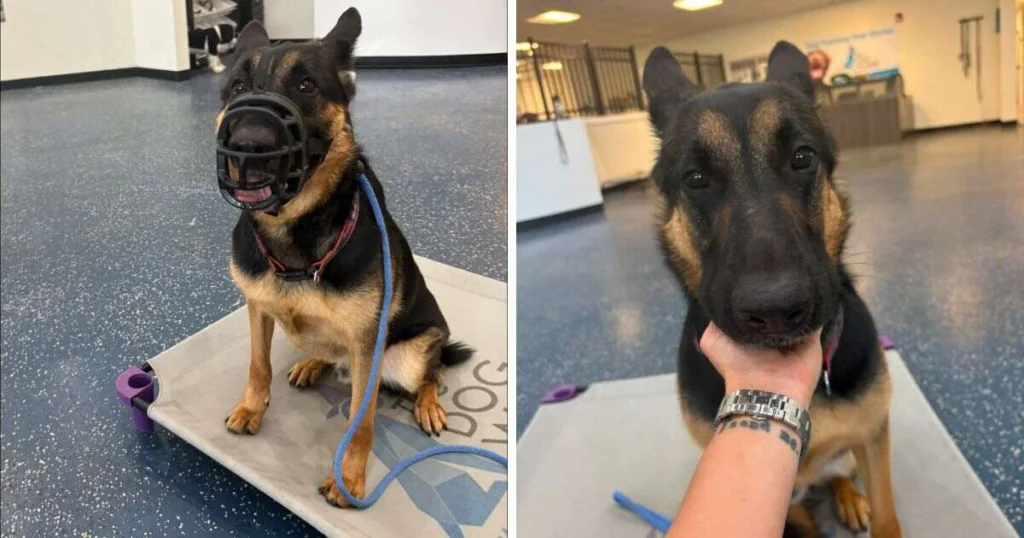
Background: Found in a canal with a severe lack of early socialization, Gator arrived at The Dog Wizard showing extreme human- and dog-targeted fear aggression and reactivity.
The Approach: Because fear aggression stems from intense self-defense instincts rather than spite, Gator’s plan relied on basket muzzle conditioning for 100% safety, structured place training to build calm focus, and patient desensitization.
The Result: In just a few days, Gator’s confidence transformed. By removing the threat of escalation and building trust, he transitioned from high-arousal reactivity to softly seeking affection and resting his chin in his trainer’s hand.
Body Language Differences: Reading Your Dog’s Signals
Signs of a reactive dog: body language signals
- Frantic movement: Rapid bouncing, spinning, and pulling in multiple directions as fear or frustration floods the dog’s system.
- Tail position: Tucked tight against the body or held high and rigid depending on whether anxiety or excitement is driving the response.
- Stress signals: Ears pinned back flat against the skull, excessive lip licking, yawning when not tired, or frantic ground sniffing indicate the emotional threshold is being exceeded.
- Whale eye: Whites become visible at the corners of the eyes as the dog tracks the trigger while simultaneously trying to look away.
- Loose body despite intensity: The body remains mobile and uncontrolled, lacking the deliberate stillness that characterizes genuine threat displays.
- Quick recovery: Once the trigger disappears from view, the reactive dog typically settles within moments, with arousal dissipating almost as quickly as it appeared.
Signs of dog aggression: body language signals
- Controlled stillness: The aggressive dog goes very still before escalating, in direct contrast to the reactive dog’s chaotic movement.
- Weight shift: Weight moves deliberately forward onto the front feet, signaling intent rather than panic.
- Hard stare: A rigid body and unblinking stare lock directly onto the target.
- Raised hackles: Hackles raise along the spine in a controlled, measured manner.
- Lip curl: Exposes canine teeth vertically, functioning as a purely visual warning signal.
- Low growl: Minimal vocalization precedes contact, a low, vibrating growl deep in the chest serving as a final warning rather than a theatrical announcement.
Learning to read these signals early gives you the best chance of intervening before a situation escalates.
Can Reactivity Turn Into Aggression?
Reactive behavior can absolutely escalate into genuine aggression without proper intervention, and understanding this progression is one of the most important reasons to address reactive patterns early.
The transformation unfolds through repeated exposure cycles. A reactive dog encounters a trigger, launches into barking and lunging, and then watches the trigger eventually disappear.
From the dog’s perspective, the explosive behavior worked perfectly. The scary thing left. So next time, the dog tries the same strategy, perhaps louder, perhaps sooner, perhaps with greater intensity.
Over many repetitions, dogs can learn to escalate from reactive displays to genuinely aggressive behavior when reactive tactics don’t produce fast enough results.
Canine aggression toward other dogs frequently develops through exactly this pathway, where initial fear-based reactivity morphs into offensive aggression after the dog discovers that escalating achieves desired outcomes more efficiently than warning displays alone.
Punishing a reactive dog adds another negative experience and suppresses visible warning signals without addressing the underlying fear, which can lead to bites that appear to come out of nowhere.
Key risk factors that accelerate the progression from reactivity to aggression:
- Repeated rehearsal of explosive behavior that “works” to remove triggers
- Punishment that suppresses warning signals without resolving underlying fear
- Prolonged exposure to triggers beyond the dog’s threshold without professional guidance
Managing Reactive Dogs: Training and Environmental Strategies
Addressing reactivity requires a layered approach that combines environmental management, systematic desensitization, and counter-conditioning. Management prevents the dog from rehearsing explosive behavior while new skills are built.
Every time a reactive dog launches into theatrical barking at another dog across the street, that neural pathway strengthens. Controlling exposure until the dog develops better coping mechanisms is a foundational part of the process.
How to manage a reactive dog: a step-by-step approach
- Control the environment first. Walk at off-peak hours when fewer triggers appear, use visual barriers like parked cars or hedges to block sightlines, and maintain sufficient distance from stimuli.
- Identify and respect threshold distance. Find the distance at which the dog notices the trigger but remains capable of disengaging. This threshold varies dramatically between individual dogs and can shift depending on arousal levels on any given day.
- Apply systematic desensitization. Expose the dog to triggers at such low intensity, usually through significant distance, that they notice without reacting. Over weeks and months, gradually decrease that distance as the nervous system adapts.
- Use counter-conditioning. Pair the appearance of a trigger with high-value rewards, rewiring the emotional response from “that’s terrifying” to “where’s my treat?” The trigger begins to predict good things rather than danger.
- Incorporate off-leash work for barrier reactive dogs. Dogs with barrier reactive tendencies benefit enormously from off-leash work in secure, trigger-free environments where the frustration of physical restraint disappears. Aggressive dogs on a leash frequently display behaviors that vanish in open spaces once leash tension no longer amplifies arousal.
- Seek professional guidance. Professional support ensures safety while implementing these protocols, particularly for dogs whose reactivity is edging toward genuine aggression.
Addressing Aggressive Behavior: Safety and Professional Intervention
Signs of dog aggression demand immediate professional assessment when behaviors escalate beyond reactive displays or when any bite incident occurs.
A qualified behavior specialist brings the expertise needed to distinguish between defensive reactions and genuine offensive intent. These professionals conduct controlled evaluations that reveal whether the dog is operating from “I need you to leave” versus “I intend to eliminate this threat.”
That distinction determines whether behavior modification is viable or whether more intensive safety protocols are necessary.
Canine aggression toward other dogs also warrants a veterinary examination before any training begins. Owners often wonder why their dog is aggressive to other dogs, and the answer sometimes lies in physical discomfort rather than behavior alone.
A dog experiencing pain may snap when touched in sensitive areas, creating behaviors that appear completely unprovoked. Medical issues including thyroid dysfunction, neurological conditions, or chronic pain can trigger or intensify aggressive responses.
Ruling out physical causes ensures the actual problem is being addressed rather than attempting behavior modification on a dog whose body is signaling a medical need.
When and how to get professional help for an aggressive dog
- Seek immediate professional assessment when behaviors escalate beyond reactive displays or when any bite incident occurs.
- Schedule a veterinary examination before any training begins to rule out pain-related aggression, thyroid dysfunction, neurological conditions, or chronic pain as contributing factors.
- Consult a qualified behavior specialist who can distinguish between defensive reactions and genuine offensive intent through controlled evaluation.
- Implement muzzle training as a vital safety measure during the assessment period. A properly fitted basket muzzle allows panting and treat consumption while preventing bite incidents, removing physical risk so handlers can remain calm during controlled exposure exercises.
- Pursue a customized modification plan that addresses the specific root cause, whether resource guarding, territorial instincts, or fear aggression, since each requires a distinct approach.
The Dog Wizard’s aggression rehabilitation program is designed specifically for dogs showing these behaviors, with customized plans that address the emotional and behavioral roots of aggression rather than just the surface symptoms.
For dogs whose aggression or reactivity stems from a difficult past, rescue rehabilitation training offers a structured path toward stability and trust.
Free evaluations are available, giving owners a clear starting point without having to guess at what their dog actually needs.
Frequently Asked Questions
How can I tell if my dog is just reactive or truly aggressive?
Look at their movement, focus, and recovery. A reactive dog is chaotic: bouncing, spinning, and barking loudly, completely loses focus on you, but settles down quickly once the trigger is gone. An aggressive dog goes very still, locks a hard stare onto the target, maintains calculated awareness of their surroundings, and stays keyed up long after the trigger disappears.
Why does my dog only act out when they are on a leash?
This is known as leash or barrier reactivity. When on a leash, a dog’s natural options to “flee” from a perceived threat are taken away. The physical tension of the leash combined with the frustration of restricted movement amplifies their arousal, causing them to lunge and bark in an attempt to scare the trigger away.
Can a dog recover from severe reactivity?
Yes. Reactivity is a behavioral pattern, not a permanent personality trait. Through a structured approach using environmental management (keeping your distance from triggers), systematic desensitization, and counter-conditioning (rewarding your dog to change their emotional response to a trigger), reactivity can be significantly managed and reduced.
Should I punish my dog for growling at other dogs or people?
No, you should never punish a dog for growling. Growling is a vital communication tool. It is your dog saying, “I am uncomfortable, please stop.” If you punish the growl, you suppress their warning system without fixing the underlying fear. This can lead to a dangerous situation where the dog bites without warning next time.
What should I do first if my dog starts showing signs of aggression?
Your very first step should be to schedule a veterinary examination to rule out pain-related aggression or underlying medical issues like thyroid dysfunction. If your dog gets a clean bill of health, you should immediately consult a qualified professional behavior specialist to safely evaluate your dog and create a customized rehabilitation plan.